

AI Learning Path
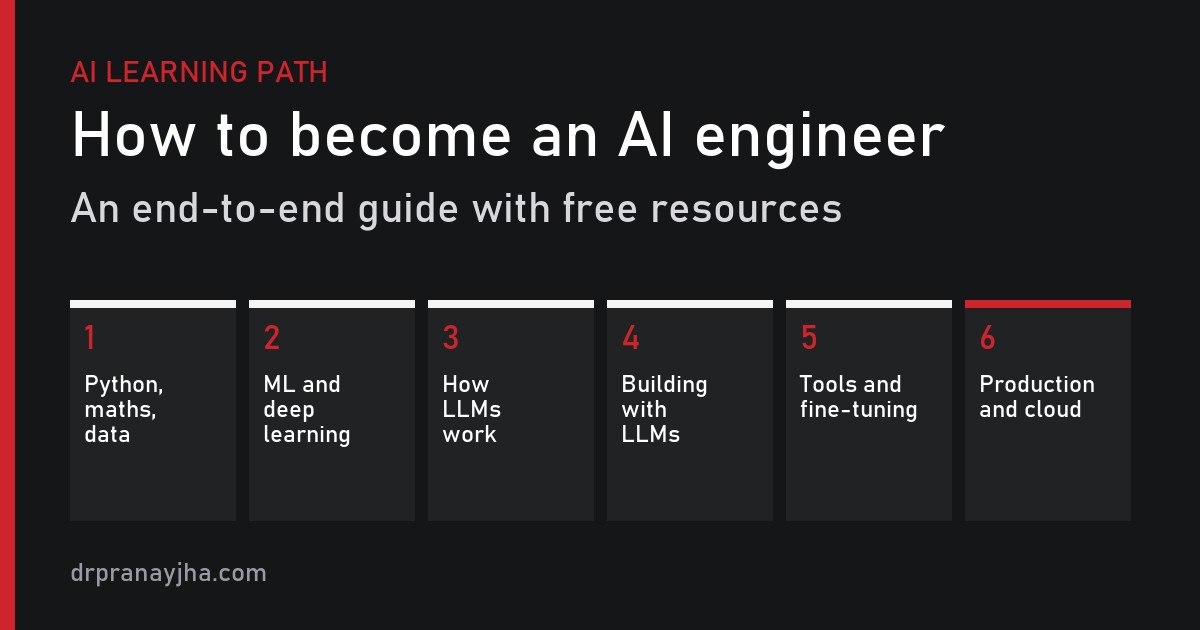
Becoming an AI engineer means learning six things in order: Python and maths, machine learning, how large language models work, building with them, the engineering tools around them, and running AI applications in production. Each stage below explains what to learn, points to free courses, playlists and books that teach it well, and ends with a project to build before you move on.
OverviewSix stages at a glance
- Python, maths, dataPython, Pandas, SQL, Git, linear algebra, statistics
- ML and deep learningMachine learning, neural networks, transformers
- How LLMs workTraining, tokens, prompting
- Building with LLMsLangChain, RAG, LangGraph agents
- Tools and fine-tuningClaude Code, MCP, FastAPI, Ollama, LoRA
- Production and cloudEvals, LLMOps, guardrails, tracing, one cloud
A few practical notes:
- Build the project at the end of each stage before starting the next one.
- Skip what you already know. If you already write Python, start with the data tools and maths.
- Expect roughly 9 to 12 months at one to two hours a day. Stages 1 and 2 take the longest.
Many playlists are from CampusX and are taught in Hindi with English terms. A section near the end lists English options. Video counts were checked in October 2026 and may change.
From an infrastructure background? An optional infra track near the end covers Linux, Kubernetes, cloud, GPUs and model serving.
Stage 1Python, maths and data
Python first, then the tools for working with data, then the maths that machine learning rests on.
| Resource | Creator | Size | What you learn |
|---|---|---|---|
| 100 Days of Python Programming | CampusX | 40 videos | Python basics: data types, input, operators, if-else, loops |
| NumPy | CampusX | 13 videos | Arrays and fast maths on data |
| Pandas | CampusX | 21 videos | Loading, cleaning and analysing tables of data |
| Complete SQL Course for Data Science | CampusX | 5 h 42 min | Querying databases |
| Git and GitHub for Beginners | freeCodeCamp | 1 h 8 min | Version control and sharing code |
| Essence of Linear Algebra | 3Blue1Brown | 16 videos | Vectors and matrices, visually |
| Essence of Calculus | 3Blue1Brown | 12 videos | Derivatives and gradients, the idea behind how models learn |
| Statistics Fundamentals | StatQuest | 62 videos | Probability and distributions; watch the first 20, return for the rest when needed |
BuildLoad a public dataset with Pandas, answer five questions about it, and push the notebook to GitHub.
Stage 2Machine learning and deep learning
How models learn from data, then neural networks, then transformers, the architecture behind large language models.
| Resource | Creator | Size | What you learn |
|---|---|---|---|
| 100 Days of Machine Learning | CampusX | 134 videos | What ML is, types of learning, the ML project life cycle |
| Neural Networks | 3Blue1Brown | 9 videos | A visual picture of how a network learns; watch before the next playlist |
| 100 Days of Deep Learning | CampusX | 84 videos | Neural networks from the perceptron up, Keras and TensorFlow projects |
| Complete Transformers for NLP in one shot | Krish Naik | 1 long video | Embeddings and self-attention, with handwritten notes |
BuildA small model that predicts something real, such as customer churn, with a short write-up of how well it does.
Stage 3How LLMs work, and prompting
What large language models are, how they are trained, and why they sometimes get things wrong, followed by how to write good prompts.
| Resource | Creator | Size | What you learn |
|---|---|---|---|
| Intro to Large Language Models | Andrej Karpathy | 59 min | A big-picture view of what an LLM is; start here |
| Deep Dive into LLMs like ChatGPT | Andrej Karpathy | 3 h 31 min | Pre-training, fine-tuning, reinforcement learning and hallucinations, without code |
| Neural Networks: Zero to Hero | Andrej Karpathy | 10 long videos | Optional deep dive: build networks and a small GPT from scratch in code, including Let’s build GPT |
| ChatGPT Prompt Engineering for Developers | DeepLearning.AI and OpenAI | 1.5 h | Writing clear prompts from code: summarising, extracting, transforming |
| Interactive Prompt Engineering Tutorial | Anthropic | 9 chapters | Hands-on exercises; pair with the prompt engineering docs |
BuildA prompt that turns messy text, such as an email or invoice, into clean JSON, tested on ten real examples.
Stage 4Building with LLMs
Calling a model from code, connecting it to your own documents (retrieval augmented generation, or RAG), and building agents that can plan and use tools.
| Resource | Creator | Size | What you learn |
|---|---|---|---|
| Generative AI using LangChain | CampusX | 21 videos | Models, prompts, structured output, parsers, chains, runnables, document loaders |
| RAG playlist | CampusX | 9 videos | Text splitters, vector stores, retrievers, Corrective RAG, Self-RAG |
| Agentic AI using LangGraph | CampusX | 28 videos | Agent concepts, sequential, parallel, conditional and looping workflows, persistence |
| Agentic AI Projects | Abhijeet Muneshwar | 7 videos | Complete agent projects built end to end |
| Agentic AI projects: End-to-End | AI with Hassan | 42 videos | Client-style agent projects; pick two or three rather than all 42 |
BuildA chatbot that answers questions from your own PDFs, then rebuilt as a LangGraph agent.
Stage 5AI engineering tools, open models and fine-tuning
Coding with an AI assistant, connecting models to other tools with MCP, serving a model as an API, and running and fine-tuning open models.
| Resource | Creator | Size | What you learn |
|---|---|---|---|
| Agentic Coding using Claude Code | CampusX | 15 videos | Setup, context window, CLAUDE.md, spec-driven development, plan mode, skills, subagents |
| Model Context Protocol (MCP Trilogy) | CampusX | 8 videos | Why MCP exists, its architecture, building MCP servers and clients |
| FastAPI for Machine Learning | CampusX | 13 videos | APIs, Pydantic, serving a model, Docker, deploying to AWS |
| Ollama Masterclass 2026 | CampusX | 2 h 49 min | Running open models on your own laptop with Ollama |
| Hugging Face LLM Course | Hugging Face | 12 chapters | Transformers library, datasets, tokenizers, fine-tuning (a text course) |
| Finetuning LLM: LoRA and QLoRA | Krish Naik Hindi | 26 min | How low-cost fine-tuning works |
| Fine Tuning LLM Models | freeCodeCamp (Krish Naik) | 2 h 37 min | Hands-on LoRA and QLoRA; the Unsloth docs help you train faster on a free GPU |
BuildWrap your Stage 4 chatbot in a FastAPI service with Docker, switch it to a local Ollama model, and fine-tune one small model on your own data.
Stage 6Production and cloud
Testing, deploying, securing and monitoring an LLM application, and running it on a cloud platform.
| Resource | Creator | Size | What you learn |
|---|---|---|---|
| LLM Evaluation | CampusX | 19 videos | Model vs application evals, LLM-as-a-judge, offline and online evals, benchmarks |
| LLMOps Course: Build, Deploy and Scale RAG AI Systems | Analytics Vidhya | 26 videos | LLMOps life cycle, model serving, hosted APIs vs open models |
| LLM Gateways: explained and crash course | Krish Naik | 2 videos | One entry point to many model providers, with routing, cost control and logging |
| Complete AI Security Course in 8 Hours | Krish Naik | 1 long video | Guardrails against unsafe or off-topic input and output, plus evals and memory |
| LLM Tracing and Observability | Arize AI | 20 videos | OpenTelemetry for AI, traces and spans, tracing tool calls, human feedback |
| Loop Engineering and Harness Engineering Crash Course | Krish Naik | 3 h 35 min | How agent loops and the harness around them are designed |
| Pick one cloud: Amazon Bedrock Getting Started, Microsoft Foundry or Google Introduction to Generative AI | AWS, Microsoft, Google | 1 to 5 h | Managed model APIs, security and cost on a cloud platform |
| AI Engineering and its free resources | Chip Huyen | 534-page book | Optional reading on how production AI applications are designed; the book is paid, the repo is free |
| AI and GenAI: Complete Guides and Series | Dr. Pranay Jha | 11 written series | Written deep dives on GenAI concepts, AWS, Azure, Google Cloud, IBM watsonx, Hugging Face, NVIDIA, Red Hat and VMware Private AI |
BuildAdd an evaluation set, one guardrail and tracing to your Stage 5 service, then deploy it on your chosen cloud. Cloud services cost money once you go past the free tier, so set a budget alert before you deploy and shut down what you are not using.
After Stage 6Final project and keeping up
Final projectOne application that uses every stage, for example a support assistant for a small business: RAG over its documents, an agent that can take actions, served with FastAPI, evaluated, guarded, traced and deployed.
AI tools change quickly. These are worth reading regularly:
- The Batch: weekly news from DeepLearning.AI
- Latent Space: podcast and newsletter for AI engineers
- Simon Willison’s Weblog: hands-on notes on new models and tools
- Import AI: weekly research roundup by Jack Clark
Optional · For infrastructure engineersInfra track: cloud, Kubernetes and AI infrastructure
Coming from infrastructure, such as VMware, cloud, networking or Kubernetes? This track covers the platform side that AI applications run on: Linux, containers, Kubernetes, automation, cloud, and then GPUs and model serving. Take it alongside Stages 5 and 6, or skip it if you work on the application side.
Platform basics
| Resource | Size | What you learn |
|---|---|---|
| Linux Zero to Hero | 13 videos | Linux basics every server and container runs on |
| Networking Fundamentals | 3 videos | IP addressing, CIDR and subnets |
| Docker | 15 videos | Containers and images |
| Kubernetes | 45 videos | Pods, deployments, services, ingress and the rest of the platform |
| Troubleshooting Kubernetes | 6 videos | Diagnosing common failures such as ImagePullBackOff |
| Ansible Zero to Hero | 11 videos | Automating server and application setup |
| Pick one cloud: AWS Zero to Hero, Azure Zero to Hero or GCP Zero to Hero in 20 Days | 16 to 40 videos | Compute, storage, networking and identity on the cloud you chose in Stage 6 |
| AI Assisted DevOps | 15 videos | Using AI tools in day-to-day infrastructure and DevOps work |
All playlists in this table are by Abhishek Veeramalla. His DevOps Zero to Hero course (59 videos) covers most of them in one series.
AI infrastructure
| Resource | Creator | Size | What you learn |
|---|---|---|---|
| What is vLLM? and Understanding vLLM with a hands-on demo | IBM Technology; KodeKloud | 5 min; 15 min | Serving open models efficiently; follow up with the vLLM quickstart |
| NVIDIA GPU Operator | NVIDIA | docs | How GPUs are made available to Kubernetes; see installing the GPU Operator |
| Cloud Native Inference at Scale with KServe | CNCF | 18 min | Running LLM inference on Kubernetes with KServe |
| Large Scale Distributed LLM Inference with llm-d and Kubernetes | Devoxx (Abdel Sghiouar) | 1 h 44 min | Optional deep dive into distributed inference on Kubernetes |
Related reading on this site: turning one laptop into a full AI and Kubernetes lab, running a 70B model without owning a GPU, one RAG chatbot on five tech stacks, and the AI Stack Builder for mapping each layer of an AI platform.
BuildDeploy your Stage 6 service on Kubernetes and automate the setup with Ansible. If you have access to a GPU, serve an open model with vLLM behind it. Then break something on purpose and use an AI assistant to help you diagnose and fix it.
In EnglishEnglish options for each stage
Swap these in for the Hindi playlists; the order of stages stays the same. Karpathy, 3Blue1Brown, StatQuest, the evaluation and observability courses and the cloud courses are already in English.
| Stage | Resource | Creator | Size |
|---|---|---|---|
| 1 | Learn Python: Full Course for Beginners or Harvard CS50P | freeCodeCamp; Harvard | 4 h 27 min; full course |
| 1 | Python NumPy Tutorial for Beginners | freeCodeCamp | 58 min |
| 1 | Pandas Tutorials | Corey Schafer | 11 videos |
| 1 | SQL Tutorial: Full Database Course for Beginners | freeCodeCamp | 4 h 20 min |
| 2 | Machine Learning Specialization (free to audit) | Andrew Ng, DeepLearning.AI and Stanford | 3 courses |
| 2 | Machine Learning for Everybody | freeCodeCamp (Kylie Ying) | 3 h 53 min |
| 2 | Practical Deep Learning for Coders or MIT 6.S191 Introduction to Deep Learning | fast.ai; MIT | full course; lectures |
| 4 | Learn RAG From Scratch | freeCodeCamp (Lance Martin) | 2 h 33 min |
| 4 | Introduction to LangGraph | LangChain Academy | online course |
| 5 | Claude Code in Action | Anthropic Academy | online course |
| 5 | Model Context Protocol Course | Hugging Face | online course |
| 5 | FastAPI Course for Beginners | freeCodeCamp | 1 h 4 min |
| 5 | Ollama Course: Build AI Apps Locally | freeCodeCamp | 2 h 57 min |
| 3 to 6 | DeepLearning.AI short courses | DeepLearning.AI | 1 to 2 h each |
Track your progress. Download the printable checklist (PDF) with every resource in this guide, and tick each one off as you finish it.
All resources listed here belong to their creators: CampusX, 3Blue1Brown, StatQuest, freeCodeCamp, Andrej Karpathy, DeepLearning.AI, Anthropic, Hugging Face, Krish Naik, Abhijeet Muneshwar, AI with Hassan, Analytics Vidhya, Arize AI, AWS, Microsoft, Google, Abhishek Veeramalla, Chip Huyen, Harvard CS50, fast.ai, MIT, LangChain, Corey Schafer, IBM, KodeKloud, NVIDIA, CNCF and Devoxx. Links and video counts were checked in October 2026.
About The Author



 DrJha
DrJha