

Generative AI · Infrastructure · Kubernetes · Solution Architecture
One AI application, followed end to end from a solution architect’s chair: how it runs today without a GPU, what VRAM and quantization really mean, what a GPU would and would not change, why token limits disappear, where Kubernetes fits, and the sizing worksheet, bill of materials and three-year cost an architect actually has to produce. Every term is explained with a plain example or a VMware equivalent.
I built a tool called DrJhaGPT Pro. It answers questions about VMware Cloud Foundation, Kubernetes and AI infrastructure by first reading my own articles and manuals, then writing an answer. The industry calls this pattern RAG, retrieval-augmented generation. It uses a 70-billion-parameter Llama model. It runs 24×7. It costs me nothing. And I do not own a GPU.
That contradiction bothered me. I design infrastructure for a living, and here was an AI application whose infrastructure I could not draw. So I asked the questions I would normally be embarrassed to ask in a customer meeting. This post is those questions, in the order I asked them, arranged along the lifecycle of one application: discover, design, size, build, run, evolve.
MapThe lifecycle of one AI application
A solution architect does not think in products; they think in phases with a deliverable at the end of each. Here is how the rest of this post lines up with that lifecycle. If you only read one table, read this one.
| Phase | The question an architect must answer | Deliverable | Covered in |
|---|---|---|---|
| Day 0 · Discover | What does the business need, and what may the data never do? | Requirements sheet (the ten inputs) | Question 8, Step 0 |
| Day 0 · Design | Which layers exist, and what runs at each? | Layer diagram and product bill of materials | Questions 1, 2, 3 |
| Day 0 · Size | How many GPUs, how much memory, disk, power? What does it cost over three years? | Sizing worksheet, hardware BOM, TCO | Questions 4, 5, 8 |
| Day 1 · Build | How do the pieces get deployed and wired together? | Kubernetes manifests, runbook | Questions 6, 7 |
| Day 2 · Run | Who watches it, patches it, backs it up? | Operations model | Question 7, rules 5 to 8; Question 8, Step 8 |
| Evolve | How do we swap the model, add users, move to a second site? | Roadmap | Question 9 |
Question 1 · DesignIs a RAG tool “an application”? Where does it sit in the stack?
Yes. It sits at the top. An enterprise AI stack is a set of layers, and a RAG tool lives in the application layers and consumes everything underneath. Once I laid my own tool over those layers, the whole picture became obvious, and so did what I was renting rather than running.
| Layer | What it does (plain words) | DrJhaGPT Pro today | Fully open-source equivalent |
|---|---|---|---|
| Location | Where it physically runs | Streamlit Community Cloud + Supabase (cloud) | Your own server, any Kubernetes |
| App / agent framework | The web page and the RAG logic | Streamlit, Python (already open source) | Same, or Chainlit / Open WebUI |
| Models | The “brain”: the file of weights that writes the answer | Llama-3.3-70B via Groq, Gemini as failover | Llama / Mistral / Qwen / Granite / gpt-oss |
| Model serving | The program that loads the brain and answers API calls | Groq API (SaaS) | vLLM or Ollama, same API style |
| Embeddings | Turns text into numbers so “similar” can be searched | fastembed, runs locally on CPU | Same |
| Vector / search database | Stores those numbers, finds the relevant pages | pgvector on Supabase + a keyword index | pgvector on your own Postgres, or Milvus / Qdrant |
| Data pipeline | Re-reads the website and refreshes the index | Nightly GitHub Action | Same, or an Argo Workflows cron |
| Identity | Who can log in, which role | Supabase Auth + role tables | Keycloak (or self-hosted Supabase) |
| Kubernetes / runtime | Keeps the containers running and connected | None; Streamlit Cloud does it | K3s, OpenShift, VKS, NKP, one container each |
| Observability | Metrics, traces, prompt logs | None | Prometheus/Grafana + Langfuse |
| Guardrails | Content and policy filters | None | NeMo Guardrails (optional) |
By code, the tool is already about 60% open source. What is SaaS is the serving (Groq), the database and identity (Supabase) and the hosting (Streamlit Cloud). Keep that split in mind; it is the answer to almost every later question.
A side note on “open source”
If your goal is “open source at every layer”, check the model licence. Llama’s licence is not OSI-approved open source. It is “open weights” with usage conditions. Mistral, Qwen, IBM Granite and OpenAI’s gpt-oss ship under Apache-2.0, which is. For an internal tool it rarely matters; for something you publish as “fully open source”, it does.
Question 2 · DesignHow is it running at all if I don’t have an A100 or H100?
Because the model is not running on my hardware. It is running on Groq’s.
When someone asks my tool a question, the Streamlit app finds the relevant paragraphs from my articles, bundles them with the question into a prompt, and sends that text over the internet to Groq’s API. Groq’s data centre runs Llama-3.3-70B on its own processors (custom chips they call LPUs, not even GPUs) and returns the answer as text. My side only runs the small pieces: the web page, the search over my index, and a tiny embedding model that is happy on a CPU.
Question 3 · DesignWhat do “VRAM” and “quantized” actually mean?
VRAM is the memory on a GPU card. To answer even one question, the entire model must sit in that memory at the same time. That is the whole constraint.
What the “70B” actually is
The 70B in Llama-3.3-70B means 70 billion parameters. A parameter is one learned number inside the neural network. When people say “weights” they mean these same numbers. The whole model is, quite literally, a very long list:
parameter 1              →   0.0134
parameter 2              →  -0.2841
parameter 3              →   1.7283
parameter 4              →   0.0047
   ...
parameter 70,000,000,000 →  -0.9182
Training is the process that finds those 70 billion values. Inference is using them. Nothing else is stored in the model file; when you download “the model” you are downloading this list.
How big is the list?
Each number has to be stored somehow, and how many bytes you spend per number is called the precision. At the precision models are trained and normally served in (16-bit, called FP16 or BF16), each number takes 2 bytes:
70,000,000,000 × 2 bytes ≈ 140 GB
| Precision | Bytes per parameter | 70B model | Where you meet it |
|---|---|---|---|
| FP32 | 4 | ≈ 280 GB | Training, scientific work; never for serving a 70B |
| FP16 / BF16 | 2 | ≈ 140 GB | “Normal” precision; how the model ships |
| FP8 | 1 | ≈ 70 GB | H100/H200 native; small quality cost |
| INT8 | 1 | ≈ 70 GB | Older quantization; still common |
| INT4 (AWQ / GPTQ) | 0.5 | ≈ 35 GB | What most people mean by “quantized” |
Pedantic but useful: 140 GB here is decimal gigabytes (140 × 10⁹ bytes). GPU spec sheets quote binary gibibytes; 140 GB is about 130 GiB. The gap is 7%, which is roughly the difference between “fits” and “does not fit” on a tight card, so keep the units straight.
No single card holds 140 GB. An A100 or H100 has 80 GB, so you need two, wired together, which is where the “you need A100s” folklore comes from.
The weights are only the first line of the memory bill
A common mistake is to stop here and say “I need a 140 GB GPU”. The weights are the fixed cost. Serving also needs memory that grows with use:
GPU memory
├── Model weights            fixed: parameters × bytes (the 140 GB above)
├── KV cache                 grows with context length × concurrent users
├── Activations / temporaries  small, per request
├── CUDA + inference engine    a few GB of fixed overhead
└── Headroom                 you want some, or the server rejects requests
The second line, the KV cache, is the one that decides the GPU count in real deployments. Question 8 puts numbers on it.
Quantization is storing each weight in 4 bits instead of 16: a rounded, compressed copy of the same model. The 70B model shrinks to roughly 35 to 40 GB. Add working space for the conversation being processed (the “KV cache”, explained in Question 8) and you arrive at about 48 GB, which fits on one L40S or one RTX 6000-class card. You lose a little precision; in document Q&A it is usually hard to notice.
Question 4 · SizeIf I buy a GPU, what will improve? How will it differ from today?
This was the answer I least expected: the answers will not get better. Same model, same weights, same output. A GPU changes where the model runs and who controls it, not how good it is.
| Groq API today | Self-hosted on your own GPU | |
|---|---|---|
| Answer quality | Llama-3.3-70B | Same model, same answers |
| Speed | Very fast; Groq’s specialty | Usually slower unless you buy serious hardware |
| Where your documents go | Leave your network, go to Groq | Stay inside your network |
| Limits | Free-tier quotas and rate limits | Whatever the card can do, 24×7 |
| Offline / air-gapped | No | Yes |
| Cost | Free tier, then per million tokens | Card + server + power + your time |
| Model upgrades | Groq adds new models | You download and swap them |
| Who patches it | Groq | You |
So the honest reasons to self-host are: privacy and compliance (a client whose manuals cannot leave the building; think DPDP Act, RBI, defence), no quotas, offline operation, and, for infrastructure people specifically, learning and credibility. An architect who has stood up Private AI end to end is a different profile from one who calls an API.
The break-even nobody shows you
Groq’s paid tier for a 70B model is on the order of ₹50 to 70 per million tokens (check the current price sheet; it changes). A single-GPU server with an L40S-class card is roughly ₹15 to 20 lakh, before power, cooling and the person who looks after it.
| Daily usage | API cost per month (approx.) | Months to pay back a ₹18 lakh server |
|---|---|---|
| 5 million tokens/day (a busy training team) | ≈ ₹9,000 | ≈ 200 months |
| 50 million tokens/day (a department) | ≈ ₹90,000 | ≈ 20 months |
| 200 million tokens/day (a product) | ≈ ₹3.6 lakh | ≈ 5 months |
Most internal tools never get near the middle row. If the reason to buy is cost, do this sum first. If the reason is privacy, the sum does not matter, and that is a perfectly good reason.
RAG changes which model you need
Because a RAG tool hands the model the relevant paragraphs, the model does not have to know the answer; it has to read and write well. That lowers the bar considerably.
| Job | Works well with | Why |
|---|---|---|
| Chat over your own documents | 8B to 14B (Llama 3.x 8B, Qwen 14B, Granite 8B) | The facts come from retrieval; the model only phrases them |
| Summarising a long manual | 14B to 32B | Needs to hold more context coherently |
| Writing a lab guide from several sources | 32B to 70B | Synthesis and structure benefit from size |
| Reasoning across conflicting sources | 70B+ or a reasoning model | This is where the big models earn their memory |
An 8B model needs about 6 GB of VRAM quantized. That runs on a laptop.
Should I self-host? Five questions
- Must the documents or prompts stay on-prem by contract or regulation?
- Are you hitting API quotas every week?
- Do you need it to work offline or in an air-gapped site?
- Do you have someone who will patch and monitor it?
- Is the goal to learn and demonstrate the stack?
Two or more “yes”: self-host. Otherwise stay on the API and spend the money elsewhere.
Question 5 · SizeIf I buy a GPU, will I still hit token limits?
No. Token limits are a business rule, not a property of the model.
Groq is sharing a fixed pool of hardware among thousands of users. To stop one person hogging it, and to nudge people toward paid plans, they cap each key: so many requests per minute, so many tokens per minute, so many per day. When the limit “expires after a while”, that is simply their meter resetting. Paid plans raise the caps; they never remove them.
On your own card there is no meter. The only limit is physics: how much work the card can do per second. The experience flips:
| Groq | Your own GPU | |
|---|---|---|
| Tokens per day | Capped by plan | Unlimited; run it 24×7 |
| Requests per minute | Capped by plan | Unlimited, but requests queue behind each other |
| “Expires” / resets | Per-minute and per-day windows | No such concept |
| When it is busy | Error: rate limit exceeded | Answers get slower; nothing is refused |
Two things feel like limits but are not. First, VRAM is finite: the conversation being processed also lives in GPU memory, so a 48 GB card running a quantized 70B model handles a few long conversations at once, not dozens; push past that and the server queues or rejects the request. That is a memory ceiling, not a quota, and it never “resets” because it was never counting. Second, a rented cloud GPU has no token limit either, but it has an hourly bill; you are limited by how long you leave it switched on.
Question 6 · BuildWhere does Kubernetes come into this?
Self-hosted, my tool becomes five programs that must run all the time: the Streamlit app, the vLLM model server, Postgres with pgvector, Keycloak for login, and later Grafana and Langfuse. Each is a container, a packaged program. Something has to start them, restart them when they crash, connect them to each other, and put each one on a machine with the right resources.
That something is Kubernetes. If you know vSphere, you already know the model:
| vSphere | Kubernetes | Role |
|---|---|---|
| ESXi host | Node | A physical or virtual server that runs workloads |
| VM | Pod (one or more containers) | The unit that actually runs |
| vCenter | Control plane | The brain: holds the desired state, schedules, heals |
| DRS | Scheduler | Decides which node a pod lands on |
| HA restart | Deployment / ReplicaSet | “Keep N copies running”; restarts a failed pod |
| VM-Host affinity rule | nodeSelector / taints and tolerations | “This workload must (or must not) run on those hosts” |
| Datastore | PersistentVolume (via a CSI driver) | Disk that survives restarts: model weights, database files |
| Port group / VIP | Service / Ingress | Stable name and IP for a pod; the entry point from outside |
| OVF template / Content Library | Container image + Helm chart | The packaged definition of an app |
| DirectPath I/O (PCI passthrough) | GPU device plugin | Hands a physical GPU to one workload |
| Host Profiles / Configuration Profiles | GitOps (Argo CD / Flux) | Desired configuration in one place, drift corrected automatically |
You describe what you want in YAML (“one vLLM pod with one GPU, one Streamlit pod, a Postgres pod with a 50 GB disk, expose Streamlit on this hostname”) and Kubernetes makes it true and keeps it true. That is its entire job.
docker compose on a single box does the same with far less to learn. Kubernetes earns its keep when you have several servers, want automatic failover, run many apps on the same GPUs, or want one deployment that works on-prem and in cloud. For learning it is exactly the right thing to practise on. For a first working version, docker compose gets you there in an afternoon.Question 7 · Build and RunWhat are the rules for running GPUs on Kubernetes?
Kubernetes does not understand GPUs out of the box. You add a few pieces once, then follow a handful of rules for every workload.
Setup, once per cluster
- GPU nodes: servers with the cards, joined to the cluster, usually in their own node pool.
- NVIDIA driver on those nodes.
- NVIDIA Container Toolkit: lets a container see the GPU.
- NVIDIA Device Plugin: tells Kubernetes “this node has 2 GPUs” so the scheduler can count them.
- DCGM exporter: GPU metrics into Prometheus.
The NVIDIA GPU Operator installs items 2 to 5 in one step. That is why it appears in every Private AI reference architecture, and why my stack builder warns you if you pick NVIDIA GPUs and Kubernetes without it.
Rules for every GPU workload
- Ask for the GPU explicitly. No request, no GPU, even on a GPU node.
- GPUs are whole units. One or two, never half. One GPU belongs to one pod at a time. (Sharing exists: time-slicing, MIG on A100/H100, or fractional scheduling with NVIDIA Run:ai. It is an add-on, not the default. Think vGPU profiles versus passthrough.)
- Keep ordinary pods off GPU nodes. Put a taint on them; only pods that tolerate it may land. Otherwise Postgres will happily occupy your ₹10-lakh node while vLLM waits. This is a “must run on hosts in group” DRS rule.
- Match the card. Label nodes by GPU type and use a nodeSelector; a quantized 70B model must land on the 48 GB card, not the 24 GB one.
- Model weights need persistent storage. vLLM downloads 35 to 40 GB on first start. Put it on a PersistentVolume or the pod re-downloads after every restart.
- One model server, not many replicas. With one GPU you run one vLLM pod; “scale to three” needs three GPUs. Scaling the Streamlit pod is fine; it is CPU-only.
- Expose it as an internal Service, never to the internet. vLLM has no authentication by default. It becomes
http://vllm:8000/v1inside the cluster; the app talks to it, the world talks to the app. - Give it time to start. Loading 40 GB takes minutes; without a long startup grace period Kubernetes decides it is dead and restarts it in a loop.
Rules 1, 3, 4, 5, 6 and 8 in one place:
apiVersion: apps/v1
kind: Deployment
metadata: { name: vllm }
spec:
  replicas: 1                          # rule 6: one GPU, one server
  selector: { matchLabels: { app: vllm } }
  template:
    metadata: { labels: { app: vllm } }
    spec:
      nodeSelector: { gpu: l40s }      # rule 4: land on the 48 GB card
      tolerations:                     # rule 3: allowed onto the tainted GPU node
        - key: nvidia.com/gpu
          operator: Exists
          effect: NoSchedule
      containers:
        - name: vllm
          image: vllm/vllm-openai:latest
          args: ["--model", "<a 4-bit checkpoint of Llama-3.3-70B>", "--max-model-len", "16384"]
          resources:
            limits: { nvidia.com/gpu: 1 }   # rule 1: ask for the GPU
          volumeMounts:
            - { name: weights, mountPath: /root/.cache/huggingface }
          startupProbe:                # rule 8: minutes, not seconds
            httpGet: { path: /health, port: 8000 }
            failureThreshold: 60
            periodSeconds: 10
      volumes:
        - name: weights
          persistentVolumeClaim: { claimName: model-weights }   # rule 5
And the one line that changes in the application: the base URL that used to point at Groq now points at http://vllm:8000/v1. vLLM and Ollama both speak the same OpenAI-style API, so the rest of the code does not know the difference.
Question 8 · SizeWhat does a solution architect need to size and price this?
Everything above is the why. This section is the worksheet: the calculations I would put in front of a customer before a single purchase order. I run one worked example all the way through so the arithmetic is visible; change the inputs and the method stays the same.
The chain to keep in your head
Every sizing conversation about an LLM platform, whether the vendor is NVIDIA, Nutanix, VMware or nobody, walks the same chain left to right. If you remember one line from this post, remember this one:
model → precision → memory → concurrency & context → GPU type and count → Kubernetes scheduling → serving engine (vLLM / NIM / NAI) → endpoint → application
Each arrow is a decision that constrains the next. Pick the model and precision and the memory is arithmetic. Add concurrency and context and the KV cache is arithmetic. Memory plus measured throughput gives the GPU count. The GPU count decides the Kubernetes node pool and scheduling rules. The serving engine turns the GPUs into a URL. The application only ever sees the URL.
Step 0 · Discover: capture these ten inputs first
- Users and peak concurrent users (people mid-question at the same moment)
- Peak queries per hour and queries per day
- Tokens per query: input (system prompt + retrieved chunks + question) and output
- Longest context you must support (a 40-page manual pasted in is about 30,000 tokens)
- Latency target: first word within N seconds, full answer within M seconds
- Model(s) and precision, and whether you will keep more than one loaded
- Data classification: what may leave the network, what may not
- Availability: is downtime during patching acceptable? (decides N+1)
- Corpus size for RAG: documents, pages, growth per year
- Growth: users and tokens at 12 and 36 months
Worked example: a 50-person training organisation. Peak 20 concurrent users, 400 queries per hour at peak, 2,000 queries a day. Each query is about 3,000 input tokens (system prompt + 6 retrieved chunks + question) and about 500 output tokens. Must occasionally handle a 16,000-token context. Answers within 30 seconds. Llama-3.3-70B, 4-bit. Corpus: 1,000 PDFs of about 300 pages each. Documents may not leave the premises.
Step 1 · Tokens per day (drives the API comparison)
tokens/day = queries/day × (input + output)
2,000 × (3,000 + 500) = 7 million tokens/day ≈ 154 million/month (22 working days)
At about ₹60 per million tokens on a paid API that is ≈ ₹9,000 to 12,000 per month, ≈ ₹1.1 to 1.5 lakh a year. Keep that number; it is the yardstick everything else is measured against.
Step 2 · GPU memory: weights
weights GB = parameters × bytes per parameter × 1.1 (runtime overhead)
| Precision | Bytes / parameter | Llama 70B (with 1.1 overhead) | Llama 8B (with 1.1 overhead) |
|---|---|---|---|
| FP32 | 4 | ≈ 308 GB | ≈ 35 GB |
| FP16 / BF16 (native) | 2 | ≈ 154 GB | ≈ 18 GB |
| FP8 / INT8 | 1 | ≈ 77 GB | ≈ 9 GB |
| INT4 (AWQ / GPTQ) | 0.5 | ≈ 40 GB | ≈ 5 GB |
These are the Question 3 figures with the 1.1 runtime factor applied, which is why 140 GB shows as 154 GB here. Use this table for sizing and the earlier one for explaining.
Step 3 · GPU memory: the KV cache (the part everyone forgets)
Every conversation being processed keeps a running memory of its tokens on the GPU, the KV cache. Its size per token depends on the model’s architecture:
KV bytes per token = 2 × layers × KV heads × head dimension × bytes per value
| Model | Layers | KV heads | Head dim | KV per token (FP16) | 16k-token context |
|---|---|---|---|---|---|
| Llama-3.x 70B | 80 | 8 | 128 | ≈ 320 KB | ≈ 5.1 GB per conversation |
| Llama-3.x 8B | 32 | 8 | 128 | ≈ 128 KB | ≈ 2.0 GB per conversation |
For the worked example, 20 concurrent conversations averaging 3,500 tokens each:
20 × 3,500 × 320 KB ≈ 22 GB of KV cache
Step 4 · Add them up, pick the card
VRAM needed = weights + KV cache + ~2 GB headroom
40 + 22 + 2 = 64 GB
That does not fit on one 48 GB card. Options, in order of cost:
| Option | Usable VRAM | Consequence |
|---|---|---|
| 1× L40S (48 GB) | 8 GB left for KV after weights | About 7 concurrent at 3,500 tokens, or one 16k conversation. Too small. |
| 2× L40S, tensor-parallel (96 GB) | About 54 GB for KV | About 48 concurrent average conversations, or about 10 at 16k. Fits with headroom. |
| 1× H100 / H200 (80 / 141 GB) | About 38 / 99 GB for KV | Fits; faster; far more expensive per card and needs a data-centre-class server. |
| Switch to Llama 8B INT4 on 1× L40S | 5 GB weights + 9 GB KV | Fits on a 24 GB card. Cheapest by a mile, if the quality is acceptable for document Q&A. |
Decision for the example: 2× L40S. Note how the KV cache, not the weights, made the decision. This is the single most common sizing mistake I see: people size for the model and forget the conversations.
Step 5 · Throughput and latency (measure, don’t guess)
required aggregate output = peak concurrent × output tokens ÷ target seconds
20 × 500 ÷ 30 s ≈ 333 tokens/second across all users
A GPU’s real throughput depends on model, precision, batch size and context length, and the numbers change every quarter. Do not size from a vendor slide. Rent the exact card for an hour, load the exact model, and run vLLM’s own benchmark (vllm bench serve) with your token profile. If the measured aggregate tokens per second at your concurrency is above the required figure with 30% margin, the card count from Step 4 stands; if not, add GPUs or reduce the model. One hour of rental replaces a year of regret.
Step 6 · Storage
| Item | Formula | Worked example |
|---|---|---|
| Model weights | size per model × versions kept | 40 GB × 3 versions = 120 GB, fast NVMe (load time = read speed) |
| Vector database | chunks × (dimensions × 4 bytes + chunk text + metadata) × 1.5 index overhead | 1,000 PDFs × 300 pages × about 2 chunks/page = 600k chunks × (768×4 ≈ 3 KB + 2 KB) × 1.5 ≈ 4.5 GB. Small. Provision 100 GB and stop worrying. |
| Source documents | as-is | 1,000 PDFs × 5 MB ≈ 5 GB |
| Prompt / trace logs | queries × (input + output) × about 4 bytes/token × retention days | 2,000 × 3,500 × 4 B × 90 days ≈ 2.5 GB |
| Backups (object store) | 2× (database + documents + logs) + weights once | ≈ 250 GB; MinIO or an existing S3-compatible target |
| Server disks | everything above × 2 for growth, mirrored | 2 × 1.92 TB NVMe |
The lesson: RAG storage is trivial. A million chunks is a few gigabytes. The only storage that matters for performance is the NVMe the weights load from.
Step 7 · CPU, RAM, network, power
| Resource | Rule of thumb | Worked example |
|---|---|---|
| System RAM | ≥ 1.5× total model weights (loading stages through RAM) + 64 GB for everything else | 1.5 × 40 + 64 ≈ 124, so 256 GB (next standard size) |
| CPU | vLLM 8 to 16 cores; Postgres 4; Keycloak 2; observability 4; app 4; OS/K8s 4 | 2 × 16-core |
| Network | 25 GbE for a single inference node; 100 GbE / InfiniBand only for multi-node training | 2 × 25 GbE |
| Power | L40S 350 W; H100 PCIe 350 W; H100 SXM 700 W; plus about 500 W for the server | 2 × 350 + 500 ≈ 1.2 kW, about 10,500 kWh a year |
| Rack | 2U for a 2-GPU server; an 8-GPU HGX is 6 to 8U and about 10 kW, a rack-power conversation | 2U, standard 32 A feed |
Step 8 · Availability
One server means downtime for every kernel patch, driver update and model swap. If that is not acceptable, the BOM doubles (a second server, N+1) and Kubernetes starts to earn its keep: it drains one node while the other serves. For a training team a maintenance window is usually fine. For a customer-facing product, budget for two.
Step 9 · Software: what is licensed by what unit
| Layer | Open-source route (₹0 licence) | Commercial route | Licensed per |
|---|---|---|---|
| Kubernetes | K3s / RKE2 / upstream | OpenShift, VKS (inside VCF), NKP | Core / socket / node |
| GPU software | NVIDIA GPU Operator + vLLM | NVIDIA AI Enterprise (NIM, support) | Per GPU per year (list ≈ US$4,500) |
| GPU scheduling | Kubernetes device plugin (whole GPUs) | NVIDIA Run:ai (fractions, quotas) | Per GPU |
| Vector DB | pgvector / Milvus / Qdrant | Zilliz Cloud, Pinecone | Per vCU / per pod |
| Identity | Keycloak | Entra ID, Okta | Per user |
| Observability | Prometheus / Grafana / Langfuse | Datadog, Dynatrace | Per host / per GB ingested |
| Backup | Velero | Veeam Kasten, Portworx Backup | Per node |
| Guardrails | NeMo Guardrails | Vendor content-safety APIs | Per call |
For the example I take the open-source route everywhere and add NVIDIA AI Enterprise as an option line. It is what a customer buys when they want a phone number to call at 2 a.m., and it is what the VMware / Nutanix / HPE / Dell bundles include.
Step 10 · The bill of materials
| Line | Item | Qty | Indicative ₹ (list, one-time) |
|---|---|---|---|
| 1 | 2U GPU server, 2 × 16-core CPU, 256 GB RAM, 2 × 1.92 TB NVMe, 2 × 25 GbE, redundant PSU, 3-year warranty | 1 | ₹9 to 11 lakh |
| 2 | NVIDIA L40S 48 GB | 2 | ₹16 to 18 lakh |
| 3 | Rack, PDU, 25 GbE switch ports | Existing / ₹1 lakh | |
| 4 | Linux + K3s (or RKE2) + NVIDIA GPU Operator | ₹0 | |
| 5 | vLLM + Llama-3.3-70B INT4 weights | ₹0 | |
| 6 | PostgreSQL + pgvector; Keycloak; Prometheus/Grafana; Langfuse; Velero; MinIO | ₹0 | |
| 7 | Application (Streamlit RAG app) | Existing | |
| Total hardware | ≈ ₹26 to 30 lakh | ||
| Option A | NVIDIA AI Enterprise subscription | 2 GPUs × 3 yr | ≈ ₹22 lakh over 3 years |
| Option B | Second identical server for N+1 | 1 | ≈ ₹26 to 30 lakh |
| Option C | OpenShift instead of K3s (for a supported platform) | 32 cores × 3 yr | Quote |
Step 11 · Three-year TCO versus the API
| Cost line | Self-hosted (open-source route) | Paid API |
|---|---|---|
| Hardware | ₹28 lakh | ₹0 |
| Power (10,500 kWh × ₹9 × 3 yr) | ≈ ₹2.8 lakh | ₹0 |
| Warranty / support renewals | ≈ ₹2 lakh | ₹0 |
| People (0.4 FTE platform engineer × ₹10 lakh × 3 yr) | ≈ ₹12 lakh | ≈ ₹1.5 lakh (0.05 FTE) |
| Tokens (154 M/month × ₹60 × 36) | ₹0 | ≈ ₹3.3 lakh |
| Three-year total | ≈ ₹45 lakh (+₹22 lakh with NVIDIA AIE, +₹28 lakh for N+1) | ≈ ₹5 lakh |
| Break-even usage | Self-hosting becomes cheaper only above roughly 70 to 90 million tokens per day at this hardware size (₹45 lakh ÷ 36 months ÷ ₹60 per million ≈ 2 billion tokens a month), more than ten times the example’s load. | |
Step 12 · The cheap variant, for contrast
Same organisation, but the team accepts an 8B model for document Q&A after a two-week trial on the API. Weights 5 GB + KV 9 GB = 14 GB, so one 24 GB card (an RTX 6000-class workstation GPU, or one L40S with room for a second model). Server ≈ ₹6 to 9 lakh all-in. Three-year TCO ≈ ₹18 lakh. The model choice moved the bill by ₹27 lakh; nothing else in the design changed. Run the quality trial before the sizing exercise, not after.
Architect’s checklist before the purchase order
- Ten inputs from Step 0 signed off by the business, not assumed by IT
- Model quality trial done on the API with real documents; size decided after
- VRAM = weights + KV cache + headroom, at peak concurrency and longest context
- Throughput measured on a rented identical GPU with
vllm bench serve, 30% margin - N+1 decision written down with the maintenance window it implies
- Three-year TCO side by side with the API, break-even stated in tokens per day
- The one requirement that justifies self-hosting named in the first paragraph of the proposal
- Licence units confirmed with vendors (core / GPU / node / user), never from a blog
- Model licence checked (open weights vs open source) against how the tool will be distributed
- Power, rack-U and network ports confirmed with the data-centre team
The Enterprise AI Stack Builder produces the product-level bill of materials (the “what”) for any design you click together; this section is the sizing behind it (the “how many”). Together they are the two halves of a solution document.
Question 9 · Run and EvolveSo what would I actually do, and tell a client?
Keep the API for the live tool. It works, it is free at my volume, and the model quality is the ceiling for that model regardless of where it runs.
Do not buy an A100 or H100. If you want the hands-on experience, and if you are in infrastructure you should, there are two cheap routes:
- Ollama on your laptop with an 8B model. Free, thirty minutes, shows you the whole self-hosting flow. Weaker answers, fine for learning.
ollama run llama3.1:8b - Rent a GPU by the hour and run vLLM with the quantized 70B: the same model as Groq, on hardware you control, for the price of a coffee. Switch it off when done. In India, E2E Networks, Yotta, NxtGen, or AWS Mumbai
g6einstances keep the data in the country; RunPod and Lambda are the US-centric options.docker run --gpus all -p 8000:8000 -v ~/.cache/huggingface:/root/.cache/huggingface -e HUGGING_FACE_HUB_TOKEN=$HF_TOKEN vllm/vllm-openai:latest --model <a 4-bit AWQ/GPTQ checkpoint of Llama-3.3-70B> --max-model-len 16384
Self-host only for privacy, quota or offline reasons. When you do, the change to the application is a base URL. The change to your life is everything else in this post: drivers, operators, storage, backup, monitoring, patching. That is not a complaint; that is the job, and it is the job infrastructure people already know how to do.
Day 2 and beyond: what “run” and “evolve” look like
| Activity | How often | What it means on this stack | VMware equivalent |
|---|---|---|---|
| Watch GPU utilisation and memory | Continuously | DCGM metrics in Grafana; alert when KV cache is near full | Aria Operations host dashboards |
| Watch answer quality | Weekly | Langfuse traces: which questions got poor retrieval, which answers users rated down | There is no equivalent; this is new work |
| Patch OS, driver, Kubernetes | Monthly | Drain the node, patch, rejoin. With one server that is a maintenance window | Lifecycle Manager, rolling remediation |
| Swap or add a model | Quarterly | Download new weights to the PersistentVolume, change one argument, restart the pod, re-run the quality trial | New OVF in the Content Library |
| Re-index the documents | Nightly | The data pipeline re-embeds changed documents | Backup job |
| Back up and test restore | Weekly / quarterly | Velero to MinIO: database, documents, config. Weights can be re-downloaded | Backup + DR test |
| Add users or a second site | As needed | Streamlit scales on CPU; the GPU is the bottleneck. A second site is a second server plus GitOps, which is where Kubernetes pays back | Add a host; add a cluster |
What I would tell a client is the table from Question 1 and the TCO from Question 8, side by side. The vendor “Private AI” bundles are this stack with the sharp edges filed off and a support contract attached. Whether you buy the bundle or assemble it yourself, you should be able to point at every row and say what runs there, why, and what it costs over three years.
Try it yourself
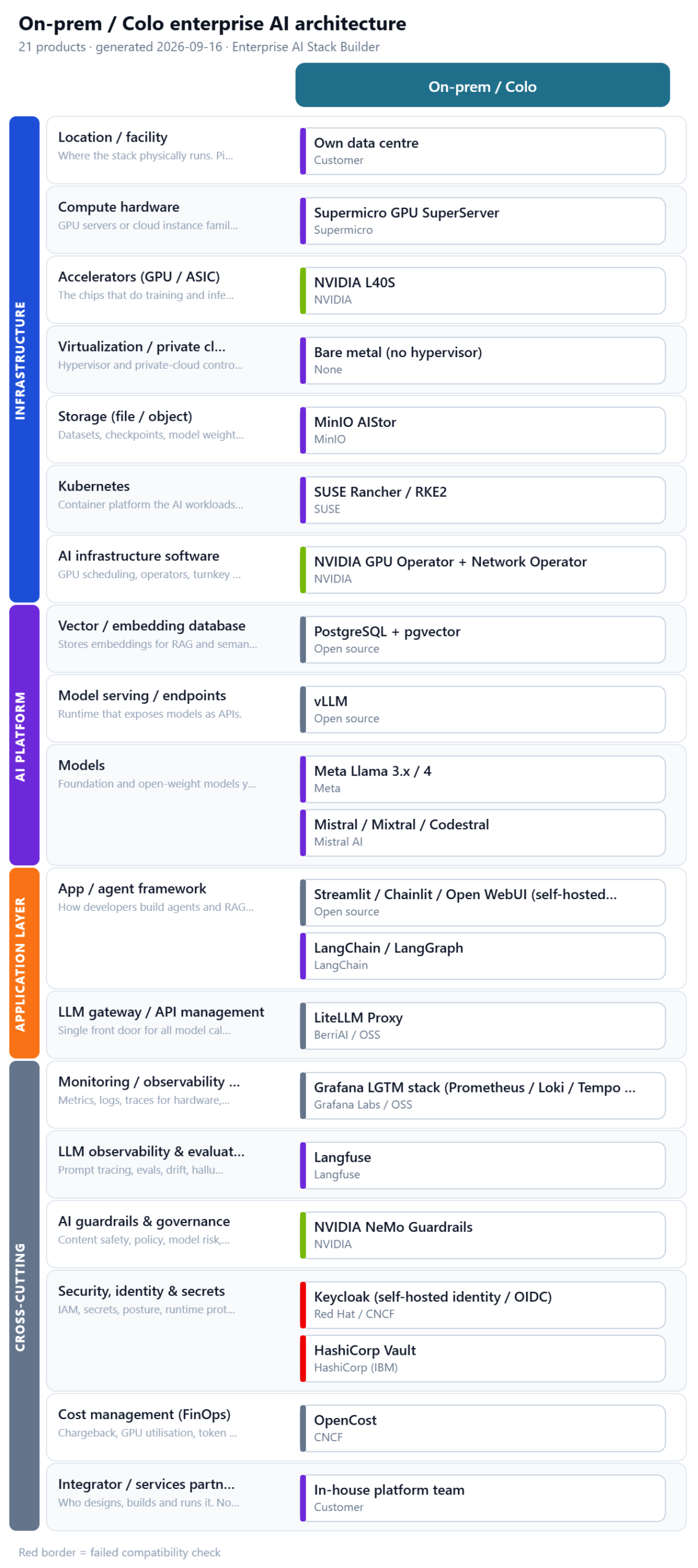
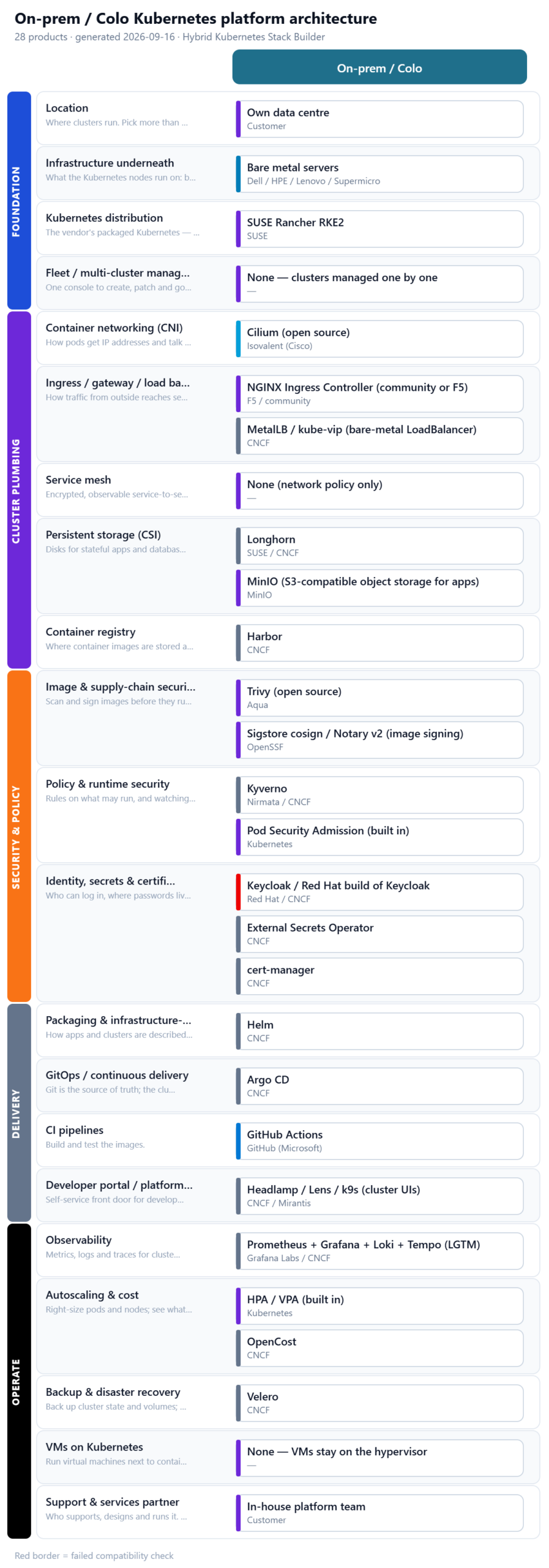
Both diagrams in this post came from two free tools on this site. The Enterprise AI Stack Builder lets you pick a product for every layer (GPUs, VMware / Nutanix / OpenShift, Kubernetes, storage, models, serving, observability, cost) across on-prem and cloud, and draws the architecture as you go. The Hybrid Kubernetes Stack Builder does the same for everything around a cluster. Load the “Open-source RAG studio” template and you are looking at the self-hosted version of the tool you just read about.
Glossary, with the everyday equivalent
- Token
- A piece of text about three-quarters of a word long. Models read, write, and get billed in tokens. A million tokens is roughly ten novels.
- Context window
- How many tokens the model can hold in mind at once: your question, the retrieved paragraphs and the answer combined. Like the size of the desk you are allowed to spread papers on.
- Inference
- Using a trained model to produce answers. Everything in this post. Running the VM, not building the golden image.
- Parameter / weight
- One learned number inside the model. “70B” means 70 billion of them. One dial on a 70-billion-dial mixing desk.
- Precision (FP32 / FP16 / FP8 / INT8 / INT4)
- How many bytes are spent storing each parameter: 4, 2, 1, 1, 0.5. Fewer bytes means a smaller model in memory and slightly less accuracy.
- VRAM
- Memory on the GPU card. The whole model must fit in it, like a VM’s reservation must fit in host RAM.
- Quantization
- Storing model weights in fewer bits (4 instead of 16) so the same model fits in less VRAM, at a small cost in precision. JPEG instead of RAW.
- KV cache
- The GPU memory a conversation occupies while it is being processed, about 320 KB per token for a 70B model. Grows with concurrent users and context length; the sticky notes on the desk. The usual reason a card that “fits the model” still runs out of memory.
- Tensor parallel
- Splitting one model across two or more GPUs in the same server so their VRAM adds up. RAID 0 for models.
- RAG
- Retrieval-augmented generation: find the relevant text first, then let the model write from it. An open-book exam.
- Embedding
- A list of numbers that represents the meaning of a piece of text, so “similar” can be computed. A library index card with a 768-digit shelf number.
- Vector database
- A database that stores embeddings and finds the nearest ones fast: pgvector, Milvus, Qdrant. The vCenter inventory search for paragraphs.
- Pod / Node
- Kubernetes’ VM and ESXi host, respectively.
- Taint / toleration / nodeSelector
- Kubernetes’ VM-Host affinity rules: keep the wrong workloads off the GPU hosts and put the right ones on them.
- CNI / CSI
- The plug-in standards for Kubernetes networking and storage. Think NSX and vSAN drivers, but vendor-neutral.
- GPU Operator
- NVIDIA’s installer that puts drivers, container toolkit, device plugin and metrics on every GPU node of a cluster. The vGPU Manager bundle, for Kubernetes.
- Open weights
- A model whose weights you can download and run, but whose licence carries conditions (Llama). Distinct from OSI open source (Mistral, Qwen, Granite, gpt-oss).
- N+1
- One more server than you need, so one can be down. HA admission control.
- TCO
- Total cost of ownership: hardware, power, licences, support and people over the life of the system, not just the purchase price. The car over three years, not the showroom sticker.
Disclosure: DrJhaGPT Pro is my own tool. Groq’s free tier, pricing and limits are as observed at the time of writing and change frequently; treat every rupee figure above as an order of magnitude, not a quote. The KV-cache formula uses Llama-3’s published architecture and differs for other model families.
About The Author



 DrJha
DrJha