
Tag: llm
-
Errors, Retries, Rate Limits and Timeouts in LLM Applications (AI Engineering Series, Part 6)
Stock SDK retry settings send three requests in 1.5 seconds when the server asked you to wait two minutes. Here is what the defaults actually do, measured, and the retry policy I ship instead.
-
Token Budgets, Context Limits and Cost per LLM Request (AI Engineering Series, Part 5)
One tool schema adds 389 tokens to every request. A newer tokenizer can add 30 percent to your bill with no price change. Here is how to measure token cost before a request leaves your process, and what our documentation assistant actually costs per 1,000 calls.
-
Structured Output From an LLM: JSON Mode, Schemas and Validation That Does Not Fail Silently (AI Engineering Series, Part 4)
Constrained decoding guarantees the shape of a model response, not its truth. Here is how JSON mode, strict JSON schemas and a second validation layer fit together, with the errors you will actually hit.
-
Prompt Patterns That Survive Contact With Real Users (AI Engineering Series, Part 3)
A production prompt is not a string, it is an ordered stack of blocks with different change frequencies. Here is the layout that survived real users, the cache mistake that cost us $612 a month, and why a longer prompt turned out to be 7.7 times cheaper.
-
Calling a Model From Python: SDKs, Messages and Parameters That Matter (AI Engineering Series, Part 2)
Your first model call from Python, with the message format explained, the parameters that actually change behaviour on current reasoning models, and the two failure modes that corrupt output silently before anyone notices.
-
What an AI Engineer Actually Does, vs ML Engineer, Data Scientist and Backend Developer (AI Engineering Series, Part 1)
An AI engineer builds applications on models somebody else trained. Here is what the job contains day to day, how it differs from ML engineering, data science and backend work, and the order I would learn it in.
-
Which Model for What: a Hugging Face Model Map for Text, Vision, Audio and Video (Hugging Face Series, Part 17)
A task-to-model map for Hugging Face: which model family to use for chat, search, transcription, speech, captioning, image and video, with sizes, licenses, the right library, and the GPU it needs.
-
Text Generation Inference (TGI) in Production: A Real Serving Example (Hugging Face Series, Part 12)
TGI turns a Hugging Face model into an OpenAI-compatible endpoint with one docker run. Here are the flags that decide whether it fits your VRAM, how to consume it, and an honest verdict now that TGI is in maintenance mode and Hugging Face points new builds at vLLM.
-
How to Run a Hugging Face Model: Inference Providers vs Endpoints vs Self-Host (Hugging Face Series, Part 11)
Three ways to serve a Hugging Face model: the serverless Inference Providers proxy, dedicated Inference Endpoints, or self-hosting TGI on your own GPUs. A build-vs-buy verdict for the infra team that owns the bill.
-
Hugging Face Tokenizers: Context Limits, Token Budgets, and Capacity (Hugging Face Series, Part 5)
Tokenizers turn text into the integers a model reads, and they decide your context limit, throughput and token bill. An infra-first guide to encoding, batching, padding waste, and what changed in Transformers v5.
-
What Hugging Face Actually Is: the Hub, the Libraries, and the Map (Hugging Face Series, Part 1)
Hugging Face is a registry, a set of open-source libraries, and a company. For infrastructure engineers moving into AI, here is the whole platform mapped onto systems you already run.
-
AI Agents: What Actually Works, and What’s Hype (GenAI Series, Part 16)
An AI agent is a model in a loop that plans, calls tools, and observes results. What agents genuinely do well today, and why reliability, not intelligence, is the real bottleneck.
Architect’s Toolkit
PJ’s Tools
- Infra 360 Hub – All Series
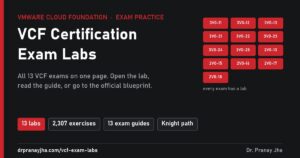
- VCF Exam Practice Labs
- VCF 9 Interactive Walkthroughs
- VCF Design Cheatsheet
- VCF Upgrade Planner
- VCF 9 Series Hub
- VCF Deployment Hub
- AI Stack Hub
- AI Infra Sizing & Cost Calculator
- LLM & RAG Cost Calculator
- DrJhaGPT – Ask Pranay
VMware Cloud Foundation
- VCF Documentation
- VCF 9 Planning & Preparation Workbook
- VCF Bill of Materials (BoM)
- VMware Compatibility Guide
- VMware Interoperability Matrix
- VMware Configuration Maximums
- VMware Ports & Protocols
- VMware Hands-on Labs
- RVTools Download
Nutanix
AI & Cloud-Native Platform
- NVIDIA Build (Model Catalog)
- NVIDIA AI Enterprise Reference Architecture
- NVIDIA NIM Performance Benchmarking
- NVIDIA NGC Catalog
- NeMo Microservices Helm Chart
- Helm Charts Repository
- Hugging Face Models
Architecture & Design
About the Author

Dr Pranay Jha
Dr. Pranay Jha is a Cloud and AI Consultant with 18+ years of experience in hybrid cloud, virtualization, and enterprise infrastructure transformation. He specializes in VMware technologies, multi-cloud strategy, and Generative AI solutions. He holds a PhD in Computer Applications with research focused on Cloud and AI, has published multiple research papers, and has been a VMware vExpert since 2016 and a VMUG Community Leader.
You May Have Missed

 DrJha
DrJha