
Category: Tech Notes
-
From Notebook to Python Package: Structuring a Data Science Project Someone Else Can Run (Data Science Series, Part 21)
A working churn notebook is not a deliverable. Here is the src layout, pyproject.toml, path handling, test suite and artifact versioning that turn 175 lines of model code into something a colleague installs and runs in one command.
-
Recommender Systems in Python: Collaborative Filtering and Cold Start (Data Science Series, Part 20)
Collaborative filtering in Python with implicit, evaluated honestly by leave one out ranking. A popularity baseline beat matrix factorisation, and a new user returned five items scored exactly zero.
-
Time Series Forecasting in Python, and Why Your Train Test Split Is Wrong (Data Science Series, Part 19)
A shuffled cross validation split on time ordered data will hand you a score you cannot ship. Here is what an honest forecast split looks like, how to backtest with a moving origin, and how far ahead a model is actually good for.
-
NLP in Python, From Bag of Words to Transformers (Data Science Series, Part 18)
Four ways to turn text into features, measured on the same split: counts, TF-IDF, frozen embeddings and a fine tuned transformer. With the latency and cost each one buys you, and where text features belong in a churn model.
-
PyTorch Essentials in Python: Tensors, Autograd and a Training Loop You Can Read (Data Science Series, Part 17)
Tensors, autograd and a hand written training loop in PyTorch 2.13, rebuilt on the churn model from Part 16. Includes the three errors that cost me the most time and an honest CPU versus GPU comparison.
-
Neural Network Fundamentals in Python, Built Up From Logistic Regression (Data Science Series, Part 16)
A neural network is logistic regression with a layer in the middle. I build one in thirty lines of numpy, then show the scaling mistake that dropped average precision from 0.5445 to 0.1062 on the churn model.
-
Hyperparameter Tuning in Python: Halving Search, Optuna and Honest Model Selection (Data Science Series, Part 15)
A random search, a halving search and an Optuna study run against the same churn model, with wall times, the honest test score, and the nested cross validation number that showed how much of the gain was imaginary.
-
Imbalanced Data and Resampling in Python Without Fooling Yourself (Data Science Series, Part 14)
Rare positive classes break accuracy, flatter ROC AUC and invite resampling mistakes that leak. Here is what actually moved the money on a churn model, with real numbers for SMOTE, class weights and threshold tuning.
-
Clustering and PCA in Python: Unsupervised Learning on Real Data (Data Science Series, Part 13)
K means and principal component analysis on the same 486 row churn frame we have modelled since Part 6. Real silhouette scores, four profiled segments, and an honest test of whether cluster labels help a classifier at all.
-
Decision Trees, Random Forests and Gradient Boosting in Python (Data Science Series, Part 12)
A single decision tree scored a perfect 1.0000 on its training data and 0.6222 on held out folds. Here is how bagging and boosting repair that, and why on our churn data the ensembles barely beat plain logistic regression.
-
Model Evaluation in Python: Metrics, Cross Validation and Data Leakage (Data Science Series, Part 11)
A single train test split moved our churn AUC by nine points depending on the seed. Here is how to pick a metric that matches the decision, read a cross validation spread honestly, and catch the leakage that manufactures scores you should not believe.
-
Logistic Regression in Python and Your First Classifier (Data Science Series, Part 10)
Build a churn classifier with logistic regression, read its coefficients as odds ratios, and learn why 73.77 percent accuracy can mean your model never predicted a single churn.
Architect’s Toolkit
PJ’s Tools
- Infra 360 Hub – All Series
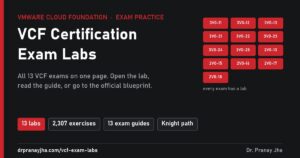
- VCF Exam Practice Labs
- VCF 9 Interactive Walkthroughs
- VCF Design Cheatsheet
- VCF Upgrade Planner
- VCF 9 Series Hub
- VCF Deployment Hub
- AI Stack Hub
- AI Infra Sizing & Cost Calculator
- LLM & RAG Cost Calculator
- DrJhaGPT – Ask Pranay
VMware Cloud Foundation
- VCF Documentation
- VCF 9 Planning & Preparation Workbook
- VCF Bill of Materials (BoM)
- VMware Compatibility Guide
- VMware Interoperability Matrix
- VMware Configuration Maximums
- VMware Ports & Protocols
- VMware Hands-on Labs
- RVTools Download
Nutanix
AI & Cloud-Native Platform
- NVIDIA Build (Model Catalog)
- NVIDIA AI Enterprise Reference Architecture
- NVIDIA NIM Performance Benchmarking
- NVIDIA NGC Catalog
- NeMo Microservices Helm Chart
- Helm Charts Repository
- Hugging Face Models
Architecture & Design
About the Author

Dr Pranay Jha
Dr. Pranay Jha is a Cloud and AI Consultant with 18+ years of experience in hybrid cloud, virtualization, and enterprise infrastructure transformation. He specializes in VMware technologies, multi-cloud strategy, and Generative AI solutions. He holds a PhD in Computer Applications with research focused on Cloud and AI, has published multiple research papers, and has been a VMware vExpert since 2016 and a VMUG Community Leader.
You May Have Missed

 DrJha
DrJha