
Category: Career Aspirants
-
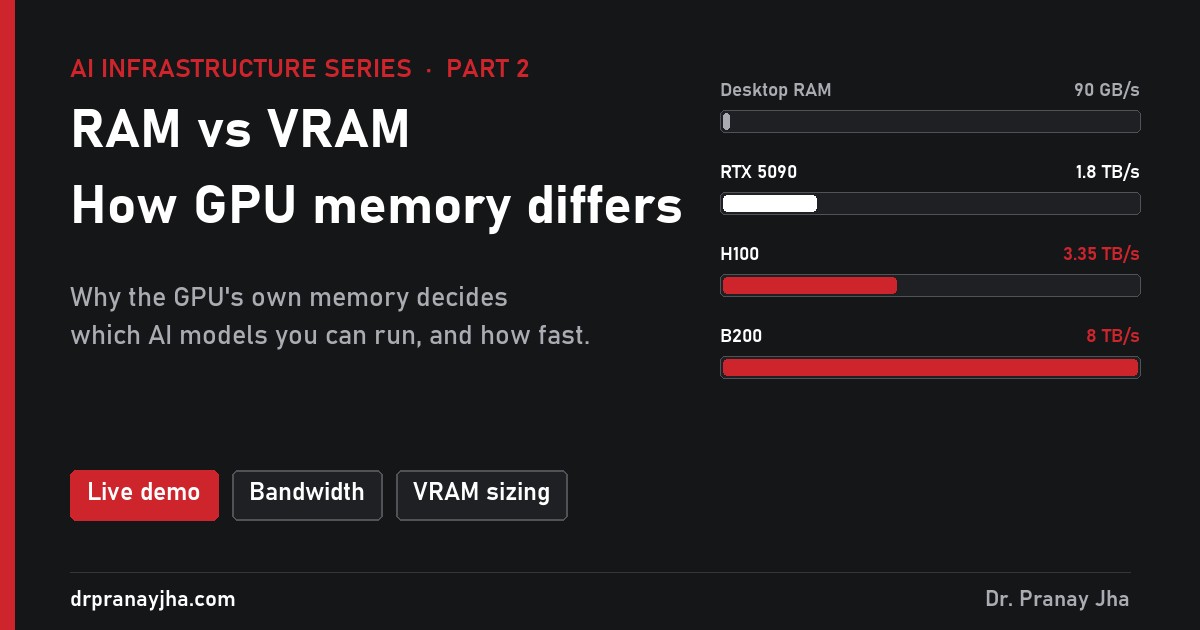
RAM vs VRAM: how is GPU memory different?
RAM belongs to the CPU, VRAM to the GPU. For AI the difference decides which models you can run and how fast they answer. Bandwidth, capacity, what happens when a model does not fit, and how much you need.
-
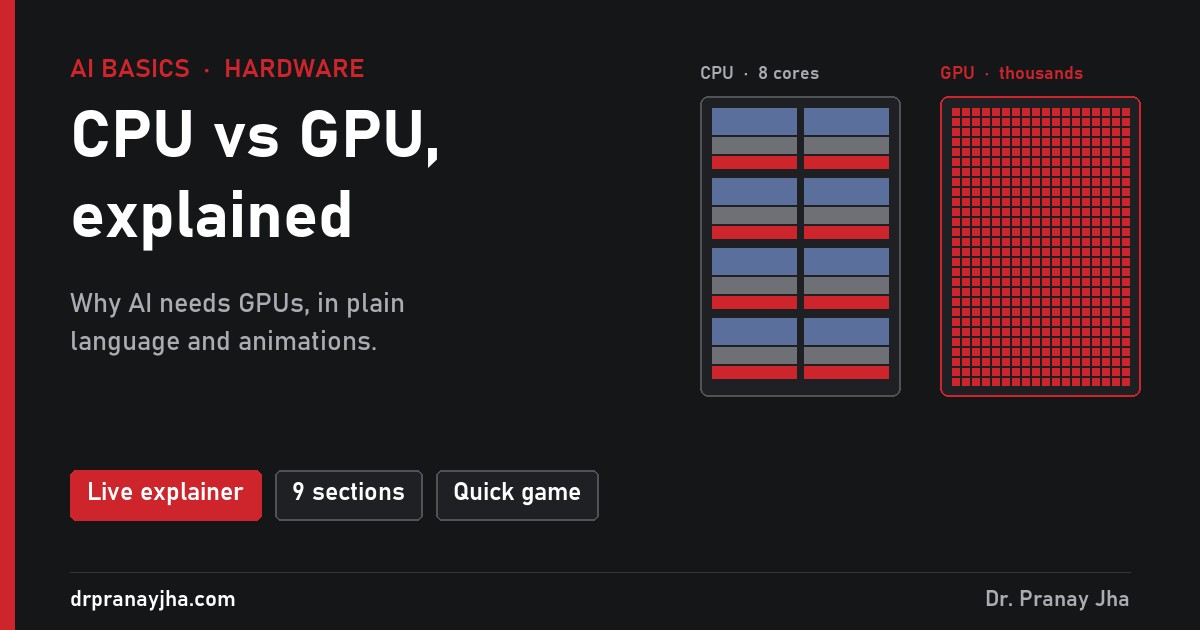
CPU vs GPU: what is the difference, and why does AI need GPUs?
A plain-language answer to the common CPU vs GPU questions: why the two chips are designed differently, why many open apps is a different kind of parallel, why AI needs GPUs, whether AI can run on a CPU, and why GPUs use more power.
-
100 hands-on lab tasks for AI infrastructure
A 100-task lab workbook for AI and GPU infrastructure roles, in learning order: Linux on GPU hosts, drivers and DCGM, Slurm, Kubernetes with the GPU Operator, Prometheus and Loki, InfiniBand and RoCE, NCCL validation, Terraform and Ansible, BCM, storage and serving, runbooks and timed scenarios.
-
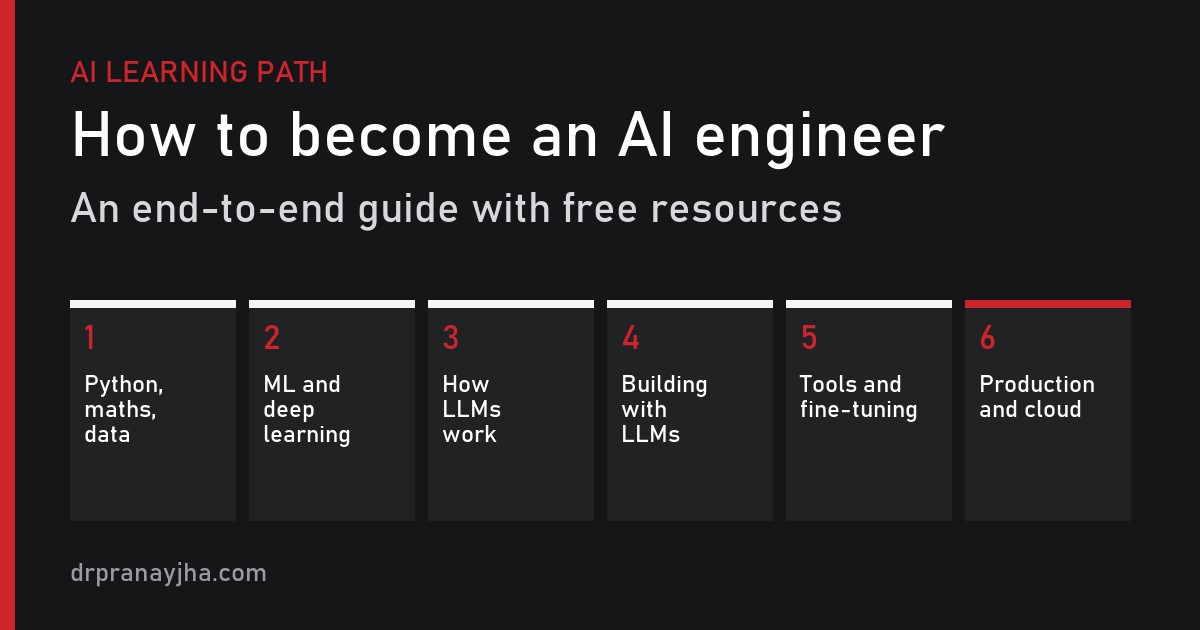
How to become an AI engineer: an end-to-end guide with free resources
Six stages, from Python and maths to building, fine-tuning and running LLM applications in production, with the free courses, playlists and books for each stage and a project to build at every step.
-
How to Become a Data Scientist From an Infra, SRE or VMware Background
If you run infrastructure, carry an SRE pager or administer VMware, you already own half of a data science career. Here is the order to build the other half, with a resource mapped to every step.
-
Data Science Interviews and Specialisation for Infra Engineers (Infra to Data Science Series, Part 26)
A data science loop runs four to six rounds, and the one that screens out switchers is the case and statistics round, not coding. Prepare for the interview that exists and specialise toward MLOps, where your operations background is an edge.
-
Data Science Portfolio and Resume for Infra Engineers (Infra to Data Science Series, Part 25)
Your infrastructure projects are already a data science portfolio. This part translates an operations resume into outcomes a data team reads and turns your telemetry work into two or three projects that get the interview.
-
Incident Prediction and AIOps, Honestly Assessed (Infra to Data Science Series, Part 24)
Incident prediction on your own telemetry usually fails on arithmetic, not modelling. A base rate check, an honest look at AIOps, and the narrow cases where prediction actually pays.
-
Log Analysis and Clustering at Scale for Infra Telemetry (Infra to Data Science Series, Part 23)
Clustering raw log lines fails because ids and timestamps make every message unique. Mine templates with Drain3 first, then cluster the structure, and a day of logs collapses to a triage table you can read in a minute.
-
Capacity Forecasting From Infrastructure Telemetry (Infra to Data Science Series, Part 22)
A straight line on a seasonal metric tells you when the average crosses your limit, not when the weekly peak does. Forecast with Holt-Winters, read the date off the upper prediction band, and plan against the risk you can afford.
-
Anomaly Detection on Metrics and Time Series for Infra Telemetry (Infra to Data Science Series, Part 21)
Static thresholds on seasonal infrastructure metrics measure the time of day, not trouble. Deseasonalise with STL, score the residual with a median and MAD based z, and reach for an isolation forest when several metrics move together.
-
Experiment Tracking and Model Registry for Infra Data (Infra to Data Science Series, Part 20)
Log every training run, register the good ones as immutable versions, and let a single champion alias decide what serves, so promotion and rollback each become one line. Built on the incident classifier, with the real failures that bite.
Architect’s Toolkit
PJ’s Tools
- Infra 360 Hub – All Series
- VCF Exam Practice Labs
- VCF 9 Interactive Walkthroughs
- VCF Design Cheatsheet
- VCF Upgrade Planner
- VCF 9 Series Hub
- VCF Deployment Hub
- AI Stack Hub
- AI Infra Sizing & Cost Calculator
- LLM & RAG Cost Calculator
- DrJhaGPT – Ask Pranay
VMware Cloud Foundation
- VCF Documentation
- VCF 9 Planning & Preparation Workbook
- VCF Bill of Materials (BoM)
- VMware Compatibility Guide
- VMware Interoperability Matrix
- VMware Configuration Maximums
- VMware Ports & Protocols
- VMware Hands-on Labs
- RVTools Download
Nutanix
AI & Cloud-Native Platform
- NVIDIA Build (Model Catalog)
- NVIDIA AI Enterprise Reference Architecture
- NVIDIA NIM Performance Benchmarking
- NVIDIA NGC Catalog
- NeMo Microservices Helm Chart
- Helm Charts Repository
- Hugging Face Models
Architecture & Design
About the Author

Dr Pranay Jha
Dr. Pranay Jha is a Cloud and AI Consultant with 18+ years of experience in hybrid cloud, virtualization, and enterprise infrastructure transformation. He specializes in VMware technologies, multi-cloud strategy, and Generative AI solutions. He holds a PhD in Computer Applications with research focused on Cloud and AI, has published multiple research papers, and has been a VMware vExpert since 2016 and a VMUG Community Leader.
You May Have Missed

 DrJha