

The GenAI wave is no longer about just calling an LLM API.
It’s about building reliable, scalable, secure, and continuously improving AI systems.
While many teams are still experimenting with prompts, enterprises are moving toward something bigger:
👉 AI factories powered by microservices
And that’s exactly where NVIDIA NeMo comes in.
The Big Picture: Enterprise AI Flywheel
At a high level, NVIDIA is pushing a powerful idea:
AI systems should continuously improve through a closed-loop pipeline.
This is what they call the AI Flywheel:
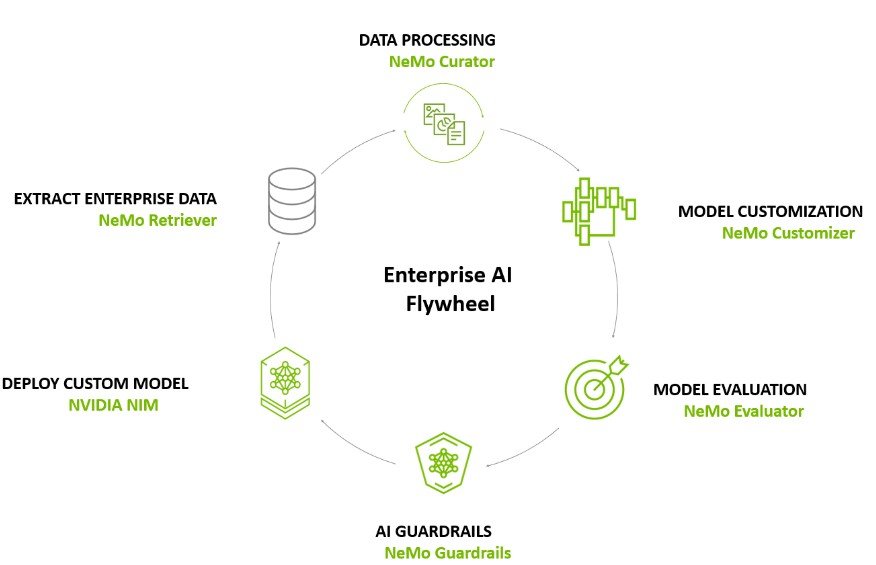
This loop ensures your AI system gets better, safer, and more aligned over time.
1. NeMo Curator — The Foundation (Data Processing)
Before training or fine-tuning, data quality decides everything.
NeMo Curator helps you build high-quality datasets through:
- Data ingestion (cloud, internet, local)
- Cleaning & preprocessing
- Deduplication (exact + semantic)
- Quality filtering (heuristics + model-based)
- Synthetic data generation
Why it matters:
- Removes noisy data → better model accuracy
- Prevents duplication → efficient training
- Enables scalable pipelines with GPU acceleration
In fact, it can reduce processing time from years to days and significantly boost throughput.
2. NeMo Customizer — Making Models Useful
Raw foundation models are generic.
Enter NeMo Customizer, which helps adapt models to your domain using:
- LoRA (Low-Rank Adaptation)
- SFT (Supervised Fine-Tuning)
- DPO (Direct Preference Optimization)
- P-Tuning
Key highlights:
- Single API-driven customization
- Works with models like Llama, Mistral, Nemotron
- Runs on cloud or on-prem (Kubernetes, Slurm)
Outcome:
- Faster training (~1.8x throughput)
- Domain-specific intelligence
- Lower cost vs full fine-tuning
3. NeMo Evaluator — The Missing Piece in Most AI Systems
Most teams skip this—and that’s a mistake.
Evaluation is not optional. It’s critical.
NeMo Evaluator enables:
- End-to-end agent evaluation
- Tool usage validation
- Goal adherence checks
- LLM-as-a-judge workflows
- Benchmark versioning
Why this matters:
Without evaluation:
- You don’t know if your AI is correct
- You can’t track improvements
- You can’t scale safely
With NeMo:
You reduce evaluation complexity (21 steps → ~5 steps)
Standardize evaluation across teams
4. NeMo Guardrails — Safety + Compliance Layer
Now comes the most critical layer for enterprises:
Guardrails
NeMo Guardrails provides:
- Policy enforcement
- Output filtering
- Input validation
- Safety alignment
- Integration with APIs and tools
Key insight:
You don’t just need “a model”—
You need controlled behavior.
And the best part?
You can achieve ~1.5x higher compliance with minimal latency impact
5. Agentic Evaluation — The Future of AI Systems
One of the most interesting concepts shown:
Agentic Evaluation
Instead of evaluating only outputs, you evaluate:
- Whether the agent used the right tools
- Whether it followed the correct reasoning path
- Whether it achieved the intended goal
This is a shift from:
❌ Output-based validation
✅ Behavior + decision validation
6. Putting It All Together
Here’s how a real pipeline looks:
- Curator → Prepare high-quality data
- Customizer → Fine-tune models
- Evaluator → Measure correctness & behavior
- Guardrails → Enforce safety & compliance
- NIM (Deployment) → Serve models as microservices
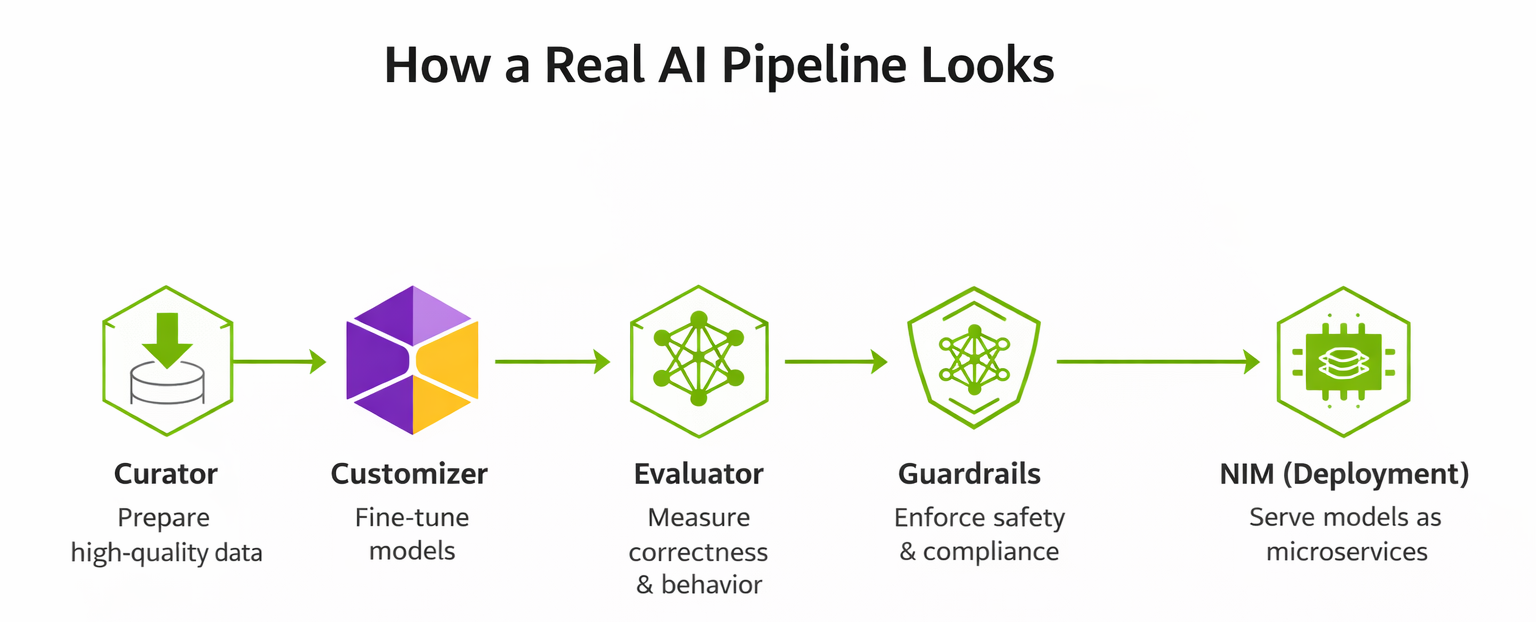
And this loop keeps running.
Why This Matters (My Take)
Most GenAI projects fail not because of models…
…but because of missing systems thinking.
NVIDIA NeMo introduces:
- Modular architecture
- Production-grade pipelines
- Continuous improvement loops
This is how you move from:
“cool demo”
to
“enterprise AI system”
Final Thought
We are entering a phase where:
AI success = Data + Customization + Evaluation + Safety + Infrastructure
Not just prompts.
And platforms like NVIDIA NeMo are quietly defining that future.
If you’re building in this space
Start asking:
- How are you evaluating your AI system?
- How are you enforcing guardrails?
- How are you improving data continuously?
Because that’s what separates POCs from production AI.
About The Author



 DrJha
DrJha